When do you need urgent help?
Call local emergency services for persistent squeezing chest pain, severe breathlessness, or sudden weakness on one side with speech difficulties. Do not put these signs down to tiredness or stress. New marked weakness or a rapidly worsening condition also needs prompt medical assessment.
How can persistent fatigue show up?
You may have finished the urgent jobs, yet making dinner or answering a message still feels like another shift. Start with what has changed in your day, rather than asking whether you are trying hard enough.
- Ordinary tasks take more effort: carrying shopping, getting ready or completing work.
- Sleep does not feel refreshing, or you become sleepy and lose concentration during the day.
- There is little energy left for people, interests or decisions after essential responsibilities.

In the institute’s model, Yav means the present: bodily sensations, circumstances and their effect on your day. You may hear the word asthenia for pronounced weakness or reduced stamina; the word alone does not explain its cause.
Why can fatigue return, and what should women check?
Fatigue can have several contributors at once. If it lasts for weeks, has no clear explanation or limits daily life, arrange a medical appointment; note changes in sleep, periods, diet, medicines and recovery after activity.
Iron stores: why haemoglobin is not the whole picture
Ferritin is a protein that stores iron. Heavy periods, pregnancy or restricted eating may make iron deficiency worth discussing; it can occur before anaemia (low haemoglobin) develops, so a normal haemoglobin result does not settle the question.
A doctor may assess a blood count and ferritin in context: inflammation can raise ferritin and complicate interpretation. Avoid choosing iron supplements or a target result from an online checklist.
Thyroid function and changes in the menstrual cycle
An underactive thyroid can be associated with tiredness, feeling cold, constipation or weight changes. When appropriate, a clinician checks thyroid-stimulating hormone (TSH), and sometimes thyroxine (T4); fatigue alone does not establish a thyroid diagnosis.
If periods change alongside hot flushes or disturbed sleep, discuss perimenopause. In otherwise healthy women aged 45 or over with a typical symptom pattern, it is usually identified clinically rather than through a broad hormone panel.
What else is useful to tell your doctor?
Mention recent pregnancy or birth, restrictive diets, new medicines and unusually heavy bleeding. Vitamin B12 testing or other investigations depend on symptoms and risk factors; there is no single set of tests for every woman.
- Describe your sleep: night waking, snoring and how you feel the next day.
- Note changes in periods, eating and medicines.
- Explain what became harder and whether activity makes symptoms worse.
Everyday pressure can also form a loop: feel depleted → think “I am falling behind” → push harder → leave less room to recover. Like a dashboard warning light, fatigue calls for attention without telling you which cause to assume.
| Pressuring advice | A more useful response |
|---|---|
| “Everyone gets tired; keep going.” | Name what has become difficult and ask for assessment or support. |
| “Check every hormone and vitamin.” | Discuss your history first, then agree which checks are relevant. |
| “You just need to manage better.” | Choose a task to postpone or share before adding another demand. |
Feeling depleted does not make you weak or at fault. You can ask for help before you have a complete explanation.
What can you explore in past experience?
In Alexander Zharkov’s approach, Nav means past experience, learned rules and recurring family patterns. The institute uses ancestral and karmic concepts as its author’s language for interpreting psychosomatic questions: how experiences and circumstances relate to bodily responses.
Here, “open loops” describes unfinished obligations that keep demanding your attention. It is a metaphor for lived overload, not a mechanism for losing iron or a diagnosis of hormonal imbalance.
- What was happening before the energy dip: interrupted sleep, conflict, deadlines or caring for others?
- What is hardest to allow yourself: a pause, saying no, leaving a task unfinished or asking for help?
- Which rule sounds familiar: “I must cope alone” or “My rest comes last”?

A useful question is smaller than “Why is my whole life like this?” Try: “Which promise can I renegotiate today?” Keep health questions and this exploration in view together.
What can you do when ordinary tasks feel too much?
If you feel depleted during a familiar day, first stop the task safely; if driving, pull over before you become too drowsy to continue. Follow any plan agreed with your clinician.
In the institute’s language, this short Zhiva practice means returning attention to bodily support and a manageable action, without trying to produce an energy surge:
- Sit with support. Feel the chair under you and place both feet comfortably on the floor.
- Release unnecessary effort. Rest your hands on your thighs and let breathing continue at an easy pace, without forced breaths or breath-holding.
- Reduce one demand. Name a task that can wait or ask someone for one concrete piece of help.
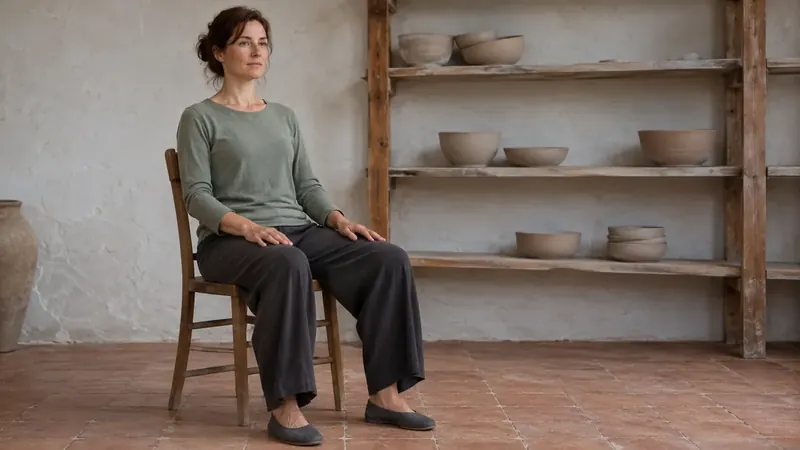
Stop if the practice is uncomfortable or makes you feel worse. It is a pause, not a test of endurance; do not push through symptoms to finish it.
How can you build support into everyday life?
In the institute’s model, Prav is the direction of future choices: “What do I want to change in my life?” Its language of Zhiva, aura and chakras describes an author’s energy framework, while everyday choices remain observable.
Energy sovereignty here means recognising your responsibility, keeping workable boundaries and choosing actions. It may look like asking a partner to take over an errand without having to prove that you are exhausted enough.
- Leave room for one pause before agreeing to another task.
- Give one request a clear scope: who does what, and by when.
- Review what changed in your day and what support is still needed.
The 40-day programme develops this author-led work through six stages involving the body, emotions, thoughts and family patterns. Compare the format with your concern; you can begin with a single consultation.
How can healthcare and work with Zhiva fit together?
You can investigate your health while also reconsidering everyday obligations. These are different questions, with different forms of support:
| Format | What it involves |
|---|---|
| Healthcare and psychotherapy | Assessment of symptoms and possible causes; treatment, follow-up or psychological support as appropriate. |
| The institute’s author-led work | Exploring one life situation, learned rules and practical choices in an agreed format. |
Yaroslava: mornings and the desire to create. In her direct-to-camera video, recorded in a car, she recalls struggling to get up at nine; after the 40-day programme, she describes enjoying a six o’clock start and wanting to create.
Difficult mornings are discussed at 01:30–01:56; creative energy and the earlier start at 02:54–03:10. These are her own observations: they do not establish a medical cause of fatigue or identify a hidden rule behind it.
Questions about fatigue and a next step
Why can fatigue seem to appear suddenly?
Sleep loss or daily demands can build up, but new marked weakness should not automatically be explained by overload. Check the warning signs at the start and seek assessment, especially if your condition changes quickly.
Why do I still feel tired after a night’s sleep?
Hours in bed are only part of the picture: interrupted sleep, snoring with breathing pauses, hot flushes and other conditions can affect recovery. If this repeats, tell your doctor about your sleep, cycle and daytime symptoms.
Where can I start if I do not understand the cause?
For your doctor, describe when the fatigue began and what became harder; you do not need a diagnosis in advance. For a personal consultation, choose one situation of overload: what happened, what you agreed to and what support was difficult to ask for.
How does a consultation with Alexander Zharkov work?
The individual consultation takes place by text: describe one situation, explore past experience and current circumstances, then consider a next step. It costs €30, and continuing a programme afterwards is optional.
Where can you start exploring your situation?
Choose one recurring situation: you want to pause but take on another task, or need help but find it hard to ask. You do not need to explain your whole life before starting.
Quantum Diagnostics is the institute’s name for a personal exploration using Alexander Zharkov’s approach: Nav brings questions to past experience, Yav describes current circumstances and Prav helps frame a next decision.
The institute reports 16 years of practice and 16,000+ clients; its founder has received eight public awards. Awards and documents.
Individual text consultation with Alexander Zharkov · €30. Continuing a programme afterwards is optional.
How the personal consultation works